
Civil Engineers help design, plan and deliver the infrastructure we use every day – including roads, bridges, subdivisions, pipelines, drainage systems, water infrastructure and major construction projects. They combine maths, science and problem-solving with practical knowledge to work out how infrastructure should be designed and built safely, efficiently and sustainably.
Civil Engineers can work in offices and on construction sites, collaborating with project managers, supervisors, surveyors, designers and construction crews.
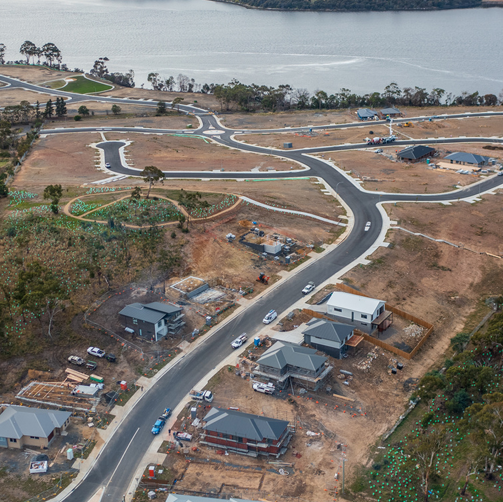
Civil engineer Career Fact Sheet
Join a growing and rewarding industry,
with excellent income potential.
Learn more about the role of a civil engineer in the civil construction industry.
A simple pathway
Here are five ideas to help you become a Civil Engineer in the civil construction industry.
1
Finish Year 12
Focus on maths and science at school to prepare for engineering study.
2
Study Civil Engineering at university
Study an Engineers Australia-accredited qualification, such as the University of Tasmania’s four-year Bachelor of Engineering (Specialisation) with Honours, specialising in Civil Engineering.
3
Get industry experience
Complete industry placements and get exposure to civil projects such as roads, bridges, subdivisions, water infrastructure and major construction. UTAS currently includes 12 weeks (450 hours) of professional industry experience in its degree.
4
Graduate and start working as a Civil Engineer
Apply for graduate or entry-level civil engineering roles with contractors, engineering consultancies, councils, government agencies or infrastructure organisations.
5
Build your professional credentials
Continue developing your experience and skills, with pathways to professional recognition through Engineers Australia and, where required for your work, engineering licensing in Tasmania.
How do I become a Civil Project Manager
Finish Year 12
If you’re still at school, subjects such as mathematics, physics and other STEM subjects are useful preparation for engineering.
↓
Study Civil Engineering at university
In Tasmania, you can study the Bachelor of Engineering (Specialisation) with Honours at the university of Tasmania and choose Civil Engineering as your specialisation.
The degree takes approximately 4 years full-time and is offered in Hobart.
During the degree, students complete practical engineering projects as well as 12 weeks of industry experience, giving you an opportunity to experience engineering in a real workplace.
↓
Get industry experience
Start building experience through university placements, vacation work, internships or graduate positions with civil contractors, engineering consultancies, councils or government organisations.
Getting onto civil construction sites is particularly valuable because it helps you understand how engineering designs are actually constructed.
↓
Graduate and start working as a Civil Engineer
After completing your engineering degree, you can apply for graduate Civil Engineer positions and begin developing your experience across areas such as:
- Roads and transport
- Bridges and structures
- Water and pipelines
- Drainage
- Subdivisions
- Earthworks
- Geotechnical engineering
- Project delivery and construction
↓
Build your professional credentials
As your career develops, you can join Engineers Australia and work towards professional credentials such as Chartered Engineer.
Chartered status is something you work towards later in your career – Engineers Australia currently requires at least five years of engineering experience before applying.
Find out more:
Find out more:
University of Tasmania – Bachelor of Engineering (Specialisation) with Honours
A VET qualification can lead to careers working alongside Civil Engineers, particularly in civil design and drafting, but a Certificate or Diploma by itself does not make you a professional Civil Engineer.
A great Tasmanian pathway is:
Certificate IV in Engineering Drafting – MEM40422
This is a practical starting point for people interested in the design and technical side of civil construction. You’ll develop skills in engineering drawings, CAD, mathematics, technical information and 2D and 3D design.
Successful completion can lead to work as an Engineering Draftsperson or further study in Civil Construction Design.
TasTAFE – Certificate IV in Engineering Drafting
↓
Diploma of Civil Construction Design – RII50520
The Diploma builds on engineering drafting skills and focuses specifically on civil infrastructure design.
You’ll learn about areas including roads, subdivisions, drainage, foundations and civil concrete structures, as well as CAD, 3D modelling and project management.
It can lead to roles such as:
- Civil Engineering Design Technician
- Civil/Structural Engineering Drafting Technician
TasTAFE currently requires the Certificate IV in Engineering Drafting for entry into this Diploma.
TasTAFE – Diploma of Civil Construction Design
↓
Work as a Civil Engineering Design Technician / Civil Draftsperson
↓
Consider further university study if you want to become a Civil Engineer
What if I am still at school?
If you’re interested in becoming a Civil Engineer, you don’t need to have everything figured out yet. While you’re at school, focus on keeping your options open and getting some experience of the industry.
- Focus on Maths – especially higher-level maths where available.
- Physics and other STEM subjects – these will help prepare you for university engineering.
- Problem-solving and design subjects – subjects involving technology, design or engineering are great choices.
- Problem-solving and design subjects – subjects involving technology, design or engineering are great choices. – look for work experience with a civil construction or engineering business.
- Problem-solving and design subjects – subjects involving technology, design or engineering are great choices. – check the entry requirements for Civil Engineering at the University of Tasmania before choosing your Year 11 and 12 subjects.
Most importantly: keep both the university and practical/VET pathways open where possible.