
Civil concreters work on the concrete structures that form part of Tasmania’s infrastructure — including roads, bridges, footpaths, kerbs, drainage structures, culverts and other major civil projects.
The job can involve preparing worksites, setting up formwork, placing reinforcement, pouring and spreading concrete, compacting it and creating the required finish.
It’s a hands-on career suited to people who enjoy working outdoors, being part of a crew and seeing the physical results of their work.
Civil concreter Career Fact Sheet
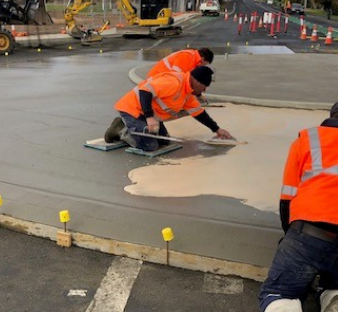
A concreter pours, spreads, smooths and finishes concrete for structures such as floors, stairs, ramps, footpaths and bridges and other kinds of
structures that need to be robust and durable.
Your pathway at a glance
The process to becoming a civil contractor.
1
Get your White Card
2
Complete entry-level civil training or find an employer
3
Start your work as a labourer or trainee
4
Complete Certificate III in Civil Construction
5
Build your concreting skills on the job
6
Become an experienced Civil Concreter
How do I become a Civil Concreter?
Before you can work on a construction site in Tasmania, you’ll need to complete General Construction Induction Training, commonly known as a White Card.
This teaches you the basic health and safety requirements for working on construction sites.
Where to start:
WorkSafe Tasmania – White Cards
Find a Registered Training Organisation
You don’t necessarily need to have a full qualification before getting your first job.
Look for entry-level positions such as:
Civil Construction Labourer → Concrete Labourer → Trainee → Civil Concreter
A Certificate II in Civil Construction (RII20720) can also be a great starting point if you’re new to the industry and want to build some practical skills before looking for ongoing employment.
TasTAFE currently offers Certificate II in Civil Construction training in Tasmania.
Find out more:
TasTAFE – Civil Construction Courses
Once you’re working in the industry, a common VET pathway is:
RII30920 – Certificate III in Civil Construction
For someone wanting to specialise in concreting, the Civil Construction (General) pathway can include concreting-related units such as:
- Carry out concrete work
- Handle concrete materials
- Use concreting materials and equipment
- Use hand and power tools
- Carry out measurements and calculations
- Read and interpret plans and job specifications
- Operate small plant and equipment
The nationally recognised Certificate III has no formal entry requirements and the Civil Construction (General) specialisation consists of 8 core units and 17 electives.
Find the qualification and RTOs:
Training.gov.au – RII30920 Certificate III in Civil Construction
Civil concreting is highly practical, so much of your development happens on the worksite.
You’ll build experience in areas such as:
Site preparation → Formwork → Reinforcement → Concrete placement → Levelling → Finishing → Curing
As you gain experience, you can work on increasingly complex civil projects and develop additional skills in plant operation, drainage, road construction and other areas of civil construction.
What else should I know?
A good place to start is:
TasTAFE
Offers civil construction training and pathways into employment.
Skills Tasmania
Find information about Tasmanian VET courses, apprenticeships/traineeships and government-supported training. Both Certificate II and Certificate III Civil Construction qualifications are identified within Tasmania’s current training needs.
Training.gov.au
Search the national register for RII30920 Certificate III in Civil Construction and Registered Training Organisations approved to deliver it.
WorkSafe Tasmania
Information about White Cards and construction safety requirements. A White Card is required for construction workers in Tasmania.
If you’re already working with concrete, talk to your employer or an RTO about completing your Certificate III. Your existing skills and experience may also be able to be recognised through Recognition of Prior Learning (RPL).
TIP: You don’t have to wait until you’re fully qualified to start your civil construction career. Getting your White Card and finding an entry-level job, traineeship or training program can be your first step.
What if I am still at school?
If you’re interested in becoming a Civil Concreter, you can start building the right skills while you’re still at school.
Focus on:
- Maths – for measurements, quantities and levels.
- English – for instructions, plans and communicating safely on site.
- Practical/Technology subjects – to build confidence with tools and hands-on work.
- VET subjects – look for civil construction or construction-related courses.
Get a head start:
Ask your school’s VET Coordinator or Career Advisor about:
- Civil construction VET courses
- Getting your White Card
- Civil construction work experience
- School-based apprenticeships or traineeships
Your Pathway
School + VET → White Card → Work Experience → Find a Civil Employer → Complete Civil Construction Training → Become a Civil Concreter
TIP: You don’t need to know everything before you start. Practical experience, a good attitude and a willingness to learn can help you get your foot in the door.