
Pipe layers play an important role in building the underground infrastructure our communities rely on every day.
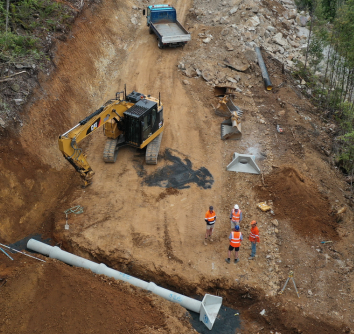
Working as part of a civil construction crew, Pipe layers install and maintain pipes and drainage systems that carry water, stormwater and sewerage. You’ll find them working on everything from new subdivisions and road projects to major water and infrastructure upgrades.
Pipe layer Career Fact Sheet
Becoming a pipe layer can be a rewarding career path for anyone who enjoys working with their hands
and performing a critical role in the community.
A simple pathway
Here are five ideas to help you become a pipe layer in the civil construction industry.
1
Get your white card
Complete White Card training with a Tasmanian RTO.
2
Find an employer
Apply for civil construction labouring, pipelaying or traineeship positions.
3
Sign up a trainee
Your employer and an Apprentice Connect Australia Provider can help establish your traineeship.
4
Complete RII30920 – Pipe Laying
Complete Certificate III in Civil Construction – Stream 3 Pipe Laying through a Tasmanian training provider such as Training Services Tasmania.
5
Learn on the job
Build your practical pipe laying skills while working with your employer.
6
Become a qualified pipelayer
Complete your Certificate III and continue building your experience in Tasmania’s civil construction industry.
How do I become a pipe layer?
A White Card is required to work on construction sites in Tasmania.
You complete the unit CPCWHS1001 – Prepare to Work Safely in the Construction Industry through a Registered Training Organisation (RTO).
There are a number of Tasmanian training providers offering White Card training.
Find a White Card course
Visit:
CCF Tasmania – Training & Courses
Use our course search to find current construction training available in Tasmania.
Skills Tasmania
Find information about training providers and vocational education available across Tasmania.
Once you have your White Card, you can start applying for entry-level jobs with civil construction contractors.
Look for positions such as:
Civil Labourer
↓
Labourer/Trainee
↓
Qualified pipe layer
You can also approach civil construction companies directly and ask whether they employ Civil Construction – Pipe Laying trainees.
You don’t need to wait until you’re qualified before applying. Your employer and training provider can help establish your traineeship.
In Tasmania, RII30920 Certificate III in Civil Construction is an approved apprenticeship/traineeship qualification.
To specialise as a pipelayer, you need to complete the:
Stream 3 – Pipe Laying
The Tasmanian nominal term for the full-time traineeship is 36 months, although completion is competency based and individual circumstances can vary.
Where can I do the qualification in Tasmania?
Training Services Tasmania (TST) currently delivers:
RII30920 – Certificate III in Civil Construction
Stream 3 – Pipe Laying
TST specialises in workplace-based civil construction training, allowing trainees to develop and demonstrate their skills while working in the industry.
Contact Training Services Tasmania:
Phone: (03) 6263 2248
Email: office@tst.com.au
Training Services Tasmania – Traineeships
How do I get qualified in Tasmania?
In Tasmania, you can complete the RII30920 Certificate III in Civil Construction (Pipe Laying) through a registered training organisation such as Training Services Tasmania and RTV Training. The qualification can be completed as a traineeship, allowing you to gain practical experience with a civil construction employer while working towards your nationally recognised qualification.
To be awarded the Certificate III in Civil Construction (Pipe Laying) the following packaging rules apply:
Total number of units = 26
8 core units plus
18 elective units, of which:
- ten (10) must be chosen from Group G
- at least one (1) must be chosen from Group H
- at least three (3) must be chosen from Group I
up to three (3) may be chosen from the electives below, elsewhere within this training package, or from another endorsed training package, or from an accredited course.
Once you’ve found an employer, your traineeship will need to be formally established.
An Apprentice Connect Australia Provider can help you and your employer set up the training contract and explain available support and incentives.
You can also contact Skills Tasmania for information about apprenticeships and traineeships in Tasmania.
Once you’ve found an employer, your traineeship will need to be formally established.
An Apprentice Connect Australia Provider can help you and your employer set up the training contract and explain available support and incentives.
You can also contact Skills Tasmania for information about apprenticeships and traineeships in Tasmania.
Where to Start
Ready to become a pipelayer?
Training Services Tasmania
For RII30920 Certificate III in Civil Construction – Pipe Laying
Visit Training Services Tasmania
Skills Tasmania
For information about Tasmanian apprenticeships, traineeships, funding and training pathways
CCF Tasmania
For civil construction training, industry information and career pathways in Tasmania
Visit our training page.
What if I am still at school?
If you’re interested in becoming a Pipelayer in civil construction, school is a great time to start building practical skills and getting experience in the industry.
- Focus on Maths – you’ll use measurements, levels, gradients and calculations on the job.
- Consider practical subjects – construction, workshop, design and technology subjects can help build useful hands-on skills.
- Look at VET opportunities – ask your school about construction or civil construction courses that can give you practical experience while you’re still studying.
- Get work experience – look for opportunities with civil contractors, earthmoving businesses, councils or companies working on water and drainage projects.
- Explore school-based apprenticeships or traineeships – you may be able to start working and completing nationally recognised training while still at school.
- Learn about workplace safety – safety is a major part of working around trenches, machinery and construction sites.
- Build your teamwork and communication skills – Pipelayers work closely with plant operators, labourers, supervisors and other trades.
- Stay active and comfortable working outdoors – pipelaying is a practical, hands-on role that can involve physical work in all kinds of conditions.
- Work towards your driver’s licence – civil construction projects can be located across Tasmania, so having a licence will be a big advantage.
- Get exposure to the industry – attend career expos, site visits and civil construction programs to see what the job is really like.
Most importantly: get as much hands-on experience and exposure to civil construction as you can. For a Pipelayer, practical skills, a good attitude, safety awareness and willingness to learn are a great place to start.